
Understanding Auroral Substorms: Science and Forecasting
For aurora chasers, understanding what triggers the most spectacular displays can mean the difference between witnessing a faint glow on the horizon and experiencing a breathtaking explosion of color. These dramatic events are known as auroral substorms and they represent one of the most dynamic processes in our near-Earth space environment.
What Is an Auroral Substorm?
An auroral substorm is a sudden, temporary intensification of auroral activity characterized by a rapid brightening, expansion, and movement of aurora displays. These events typically last 2-3 hours from onset to recovery and follow a predictable sequence of phases that aurora photographers and enthusiasts can learn to recognize.

An impressive auroral substorm expansion covering nearly the entire visible sky
The Three Main Phases of a Substorm
-
During this initial phase, energy from solar wind accumulates in Earth's magnetotail—the extended portion of our magnetosphere that stretches away from the sun. This buildup isn't easily visible to observers on the ground, though aurora may appear as a relatively stable, quiet arc low on the northern horizon.
Duration: 30 minutes to 1.5 hours
-
This is the dramatic phase aurora chasers live for. A process called "magnetic reconnection" occurs in the magnetotail, explosively releasing stored energy, like a cosmic rubber band snapping. On the ground, observers witness:
Sudden brightening of auroral arcs
Rapid poleward expansion (the aurora moves higher in the sky)
Development of intricate structures, ripples, and curls
Vibrant colors as different atmospheric gases become excited
Duration: 20-40 minutes (the most intense displays may last only 10-15 minutes)
-
After the expansion climax, the auroral oval gradually returns to a quieter state. Displays often drift southward again, becoming more diffuse with fewer defined structures. Pulsating auroras—patches of light that blink on and off every few seconds—are common during this phase.
Duration: 1-2 hours

After an intense substorm expansion, the aurora relaxes into a much dimmer and less intense recovery phase
The Science Behind Substorms
Substorms result from a complex interaction between the Sun’s solar wind and Earth's magnetosphere. The process involves:
-
The interplanetary magnetic field (IMF) carried by the solar wind connects with Earth's magnetosphere, transferring energy into Earth’s magnetotail when the IMF (Bz) points southward.
-
This transferred energy stretches Earth's magnetotail, compressing the plasma sheet (a region of denser, hotter plasma) within it.
-
When the stretched magnetic field lines reach a critical point, they "reconnect" in a different configuration, releasing enormous energy.
-
This energy accelerates charged particles toward Earth along magnetic field lines.
-
The accelerated particles collide with oxygen and nitrogen in our upper atmosphere, creating the aurora through excitation and emission of photons.
Anticipating Substorms
While predicting the exact timing of substorms remains challenging, several indicators help forecast favorable conditions:
-
Higher speeds (>500 km/s) deliver more energy to Earth's magnetosphere
Available via NOAA Space Weather Prediction Center, SpaceWeatherLive.com
-
Bz values (north-south direction of the IMF) are most relevant to aurora chasers
Southward orientation (negative Bz values) facilitates energy transfer
Strong negative values (-10nT or lower) often precede substorms
Available through: DSCOVR satellite real-time data
-
Higher density provides more particles for potential aurora displays
Available through: ACE satellite data, SpaceWeatherLive.com
-
Measures electrical currents in the ionosphere
Sudden increases indicate substorm onset
Available through: Kyoto WDC or CCMC
-
Measures magnitude and direction of Earth’s ambient magnetic field in the geosynchronous equatorial orbit (remains in orbit over designated longitudes to the west and east of North America)
Measures the general level of geomagnetic activity
Detects magnetopause crossings, sudden storm commencements, and substorms
Maps the space environment that controls charged particle dynamics in the magnetosphere (ncei.noaa.gov)
-
General measure of geomagnetic activity
Values of 4+ indicate possible substorm conditions
Values of 6+ suggest exceptional activity
Available through: multiple aurora apps and websites
Practical Forecasting Tools
A few accessible resources provide assistance with aurora forecasting:
OVATION Aurora Model: NASA/NOAA visualization showing probability and intensity of aurora activity
Aurora apps: Apps like "My Aurora Forecast" or "Aurora Now" provide notifications of heightened activity
University of Alaska Fairbanks Geophysical Institute: Provides region-specific aurora forecasts
SpaceWeatherLive.com: Offers real-time solar wind data and magnetometer readings
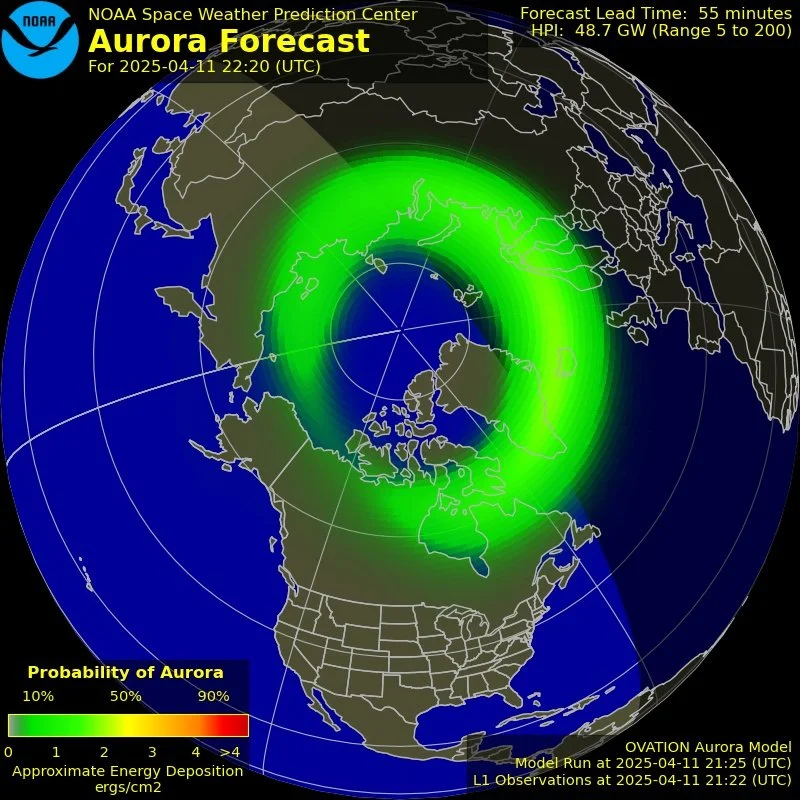
The National Oceanic and Atmospheric Administration’s (NOAA) OVATION Aurora Model, a readily available visualization of current auroral activity
Source: NOAA (https://www.swpc.noaa.gov/products/aurora-30-minute-forecast)
Recognizing Substorm Onset in the Field
Experienced aurora chasers learn to identify visual cues that a substorm expansion may be imminent:
Stable auroral arcs that slowly brighten
Small, rapid undulations or ripples along the bottom edge of an arc
Brief, localized brightening that fades, then returns more intensely
Westward-traveling surges along an auroral arc
When these signs appear, photographers should prepare for possible dramatic expansion within minutes.


Photography Tips for Substorms
Pre-focus your camera before the expansion phase
Use shorter exposures (1-5 seconds) during peak activity
Prepare wider compositions to capture the expanded aurora (it can often fill a majority of the visible sky)
Consider time-lapse to document the entire sequence
Adjust ISO and aperture rather than changing shutter speed frequently
Final Thoughts
Understanding auroral substorms adds a new dimension of appreciation for the aurora. Rather than seeing the Northern Lights as a random phenomenon, viewers can recognize that they're witnessing a dynamic and somewhat predictable process—a realtime visualization of space weather.
While forecasting still contains elements of uncertainty, the science continues to improve. For the dedicated aurora chaser, learning the signs of substorm development transforms the experience from passive observation to active participation in one of nature's most spectacular cosmic events.
-
NOAA (https://www.noaasis.noaa.gov/GOES/goes_overview.html)
SpaceWeatherLive.com (https://www.spaceweatherlive.com/en/help/the-interplanetary-magnetic-field-imf.html)
GlendaleSkye.com (https://www.glendaleskye.com/aurora-phases.php)