
The Celestial Light Show: A Brief Into the Science of the Aurora
The aurora borealis (northern lights) and aurora australis (southern lights) rank among nature's most spectacular displays. These shimmering curtains of colored light dancing across polar skies have inspired awe for millennia. But what exactly causes this wondrous phenomenon? Let's explore some of the science behind auroras.
A Dance Between Sun and Earth
Auroras begin 93 million miles away on our sun. The sun continuously emits a stream of charged particles—primarily electrons and protons—known as the solar wind. This wind travels through space at speeds between 300-800 km/s (about 1-2 million mph).
During periods of intense solar activity, particularly solar flares and coronal mass ejections (CMEs), the sun releases much larger bursts of these energetic particles into space. When directed toward Earth, these particles arrive at our planet in about 1-3 days.

Aurorae are formed as a result of the interaction between the Sun’s solar wind and Earth’s magnetic field
Source: NOAA/JPL-Caltech (https://scijinks.gov/aurora/)
Earth's Magnetic Shield
Fortunately, Earth possesses a powerful magnetic field that protects us from the harmful effects of these solar particles. Our planet's magnetic field, generated by the movement of molten iron in its core, creates a vast protective bubble called the magnetosphere.
When the solar wind encounters this magnetic field, most particles are deflected around Earth. However, some particles become trapped in the planet’s magnetic field lines. The magnetic field funnels the charged particles toward the polar regions, where they are drawn down toward the atmosphere.
The characteristic curtain-like appearance results from the alignment of these emissions along Earth's magnetic field lines, while the shimmering and pulsating effects reflect variations in the incoming solar particles.
The Collision That Creates Light
As these energetic particles—primarily electrons—descend into the upper atmosphere, they collide with gas molecules, primarily oxygen and nitrogen. These collisions excite the atmospheric gases, temporarily boosting the energy state of their electrons.
As the excited gases calm down, they release energy in the form of light—photons of specific wavelengths that we perceive as different colors.
A visual representation of interaction between particles from the sun and oxygen and nitrogen in Earth’s atmosphere
(Source: NASA/Goddard Space Flight Center/Scientific Visualization Studio/Mary P. Hrybyk-Keith (https://science.nasa.gov/sun/auroras/))
The Aurora's Color Palette
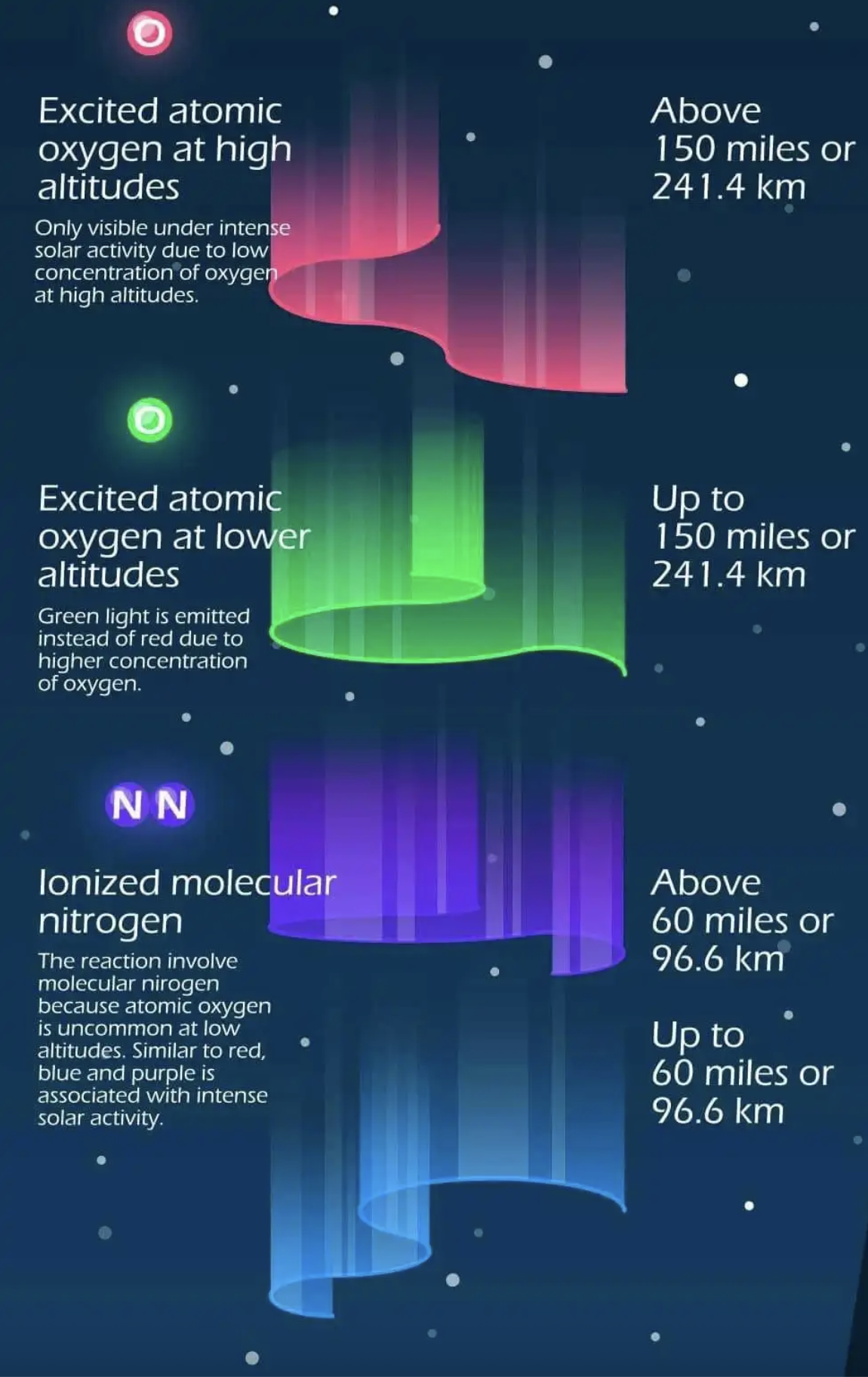
The colors of the aurora depend on which atmospheric gas is struck, the altitude of the collision, and the energy level of the incoming particles (solar wind speed, particle density, etc.).
Green aurora (the most common) occurs when oxygen molecules are excited at lower altitudes (about 60-150mi/100-200 km)
Red aurora (a rare occurrence) also results from excited oxygen molecules, but at higher altitudes (above 150mi/200 km)
Purple (below 60mi/100km altitude) and blue aurora (60-120mi/100-200km) are the result of excited nitrogen molecules

An extravagant aurora in Alaska, with a broad spectrum of reds, purples, and greens vibrantly displayed
When and Where to See Aurora
Auroras are most visible in a ring-shaped zone around the Earth's magnetic poles, known as the "auroral ovals." In the Northern Hemisphere, it typically exists between 60° and 75° latitude, encompassing places like Alaska, northern Canada, Iceland, northern Scandinavia, and Antarctica.
During periods of intense solar activity, the auroral oval can expand, making the lights visible at lower latitudes. Solar activity follows an approximately 11-year cycle, with periods of maximum activity providing more frequent and impressive auroral displays. The current solar cycle reached its peak of activity in late 2024, according to solar activity since then.
If you are in the United States, perhaps the easiest (and best) place to witness the aurora is in the Interior of Alaska, with Fairbanks being an ideal hub for exploration.

A visual representation of the northern hemisphere’s auroral oval, which crosses directly over the majority of Alaska
Source: University of Alaska Fairbanks Geophysical Institute (https://www.gi.alaska.edu/monitors/aurora-forecast)
More Than Just Beauty
Beyond their aesthetic appeal, auroras offer scientists valuable information about the interaction between our sun and Earth. By studying these phenomena, researchers gain insights into space weather, which can affect satellite communications, power grids, and astronaut safety.
Modern technology allows scientists to predict auroral activity with increasing accuracy, giving photographers and sky watchers advance notice of potential displays.
A Connection to the Cosmos
The aurora reminds us that Earth doesn't exist in isolation but is intrinsically connected to our sun and the broader universe. The dancing lights of the aurora represent a visible manifestation of the complex electromagnetic relationship between our planet and its star—a relationship fundamental to life on Earth.
The next time you're fortunate enough to witness an aurora, take a moment to appreciate not just its beauty, but also the remarkable cosmic dance of particles and energy that creates this magnificent spectacle.

A vibrant green aurora on a frigid winter night near Fairbanks, Alaska